Showing posts with label Art 235. Show all posts

Wednesday, November 30, 2011

Metalwork Through Art History


I enjoyed learning about the metalwork of pre-historic and ancient times.  The level of detail they attained with rudimentary technology and tools is pretty amazing to me.  As a metalsmith, I cannot imagine working without pressurized gas, electricity or magnification.
When I speak of metal working, I'm not talking about bronze sculptures, though the level of detail the Greeks, Etruscans, and Romans attained is quite astonishing, as in the "Equestrian Statue of Marcus Aurelius" (pg. 201).  The folds of skin under the neck of the horse and the folds of cloth on Marcus Aurelius' robe are beautiful.
I am fascinated by the hollowcore casting methods used by Greek goldsmiths, as seen on page 147 in the textbook.  These small earrings have so much detail and workmanship packed into each surface.  Even though the casting process is largely the same as it was thousands of years ago, metalsmiths these days have the luxuries of pressurized gasses, running water, and safety equipment.  Goldsmiths in the days of the Greeks were master craftsmen and worked very hard to attain quality work.
The goldsmithing of Aegean craftspeople is also quite interesting to me because of their use of filigree and granulation.  Filigree and granulation were largely forgotten until recently simply because they are difficult and tedious processes to learn.  The bee pendant on page 87 is a beautiful example of ancient granulation, and has survived the tests of time.  Try burying a painting now and seeing if it's still intact 3-4,000 years later.
The amount of resources available at this time astonishes me and I am always in awe of how much gold ancient peoples used.  The textbook did not talk about a lot of Egyptian metalwork, although they did make many things out of metal; gold was used extensively as was silver.  The Egyptians used the technique of inlay to work gold and silver, and precious and semi-precious stones into their sculptures and sarcophagi.  The bust on page 72 called "Queen Tiy" was inlayed with gold, silver, ebony, glass, and lapis lazuli.  The use of gold was to symbolize wealth and also Ra because gold is often seen as being the color of the sun.

Wednesday, November 16, 2011

Week #9: Stylization in Byzantine Art

The Old Testament Trinity (Three Angels Visiting Abraham)
Andrey Rublyov, 1410-1425
pg. 258 

Harbaville Triptych
Mid 11th Century
pg. 253


The tempera painting "The Old Testament Trinity (Three Angels Visiting Abraham)" by Andrey Rublyov 1410-1425  (pg. 258) is a stylized Byzantine painting on a panel.  The first stylization that is noticeable is the white halo behind the heads of these figures, not to mention they have wings that look like they are made of gold.  Even though there is some modeling on these figures, they still seem less naturalistc than earlier art.  The modeling is visible in the faces and the folds of the cloth they are wearing, but the heavy black outline of the figures disrupts the way the viewer sees the figures.  Although the artist painted these figures as being in a scene, with a building and a tree behind them, they still look like they are floating off the surfaces where they sit.  There is no drop shadow below their feet which makes it seem like they aren't grounded at all.  Perspective lines are slightly off, and not all that straight making the viewer have to work harder to imagine this as a real scene.  Additionally, the folds and lines of their clothing are rather geometric.  The lines are sharp, crisp and loudly outlined in black.  The faces of these figures are extremely similar, with the only differences being bags under the eyelids of the figure on the left and and slightly heavier brow on the right figure.  The heads are tilted in what could be perceived as a deferring bow, an unnatural position for a head to be seemingly stuck in for centuries, or millenia.  Overall, this painting is quite cartoonish because of the simplified modeling/shading and the heavy outlines.

The Harbaville Triptych (pg. 253) is from the mid 11th century and ushered in the idea that people wanted to personalize their praying experience.  According to Stokstad and Cothren, the figures of Mary and St. John flank Jesus and are asking him for forgiveness and salvation for the owner of this triptych.  When I look at this triptych as a whole, it seems like a box of devotional dolls.  One would be able to take out each figure and play with them like Barbies or G.I. Joe dolls, creating scenes and stories that incorporate saints and martyrs along with Jesus, Mary and St. John and some of the other apostles which are identified by the writing on the blank background.  Most figures are placed on a pedestal, standing apart from the background, which because it is plain and white, distances the figures from it, and almost isolates them.  This Byzantine sculpture shows the stylization of the figure through the large heads in proportion to the bodies, which are all slim, the same height and weight and all have very similar linear clothing. The floral patterns along the edges (registers?) are also very unnatural, they are all almost exactly the same, and don't seem to point to any real foliage that exists in nature.  The writing that is on the white background also takes away from the realism of this sculpture. Although this sculpture has more naturalism and fully realized figures than the paintings of the period, it is still very stylized.

Wednesday, November 9, 2011

Week #8: Roman Busts

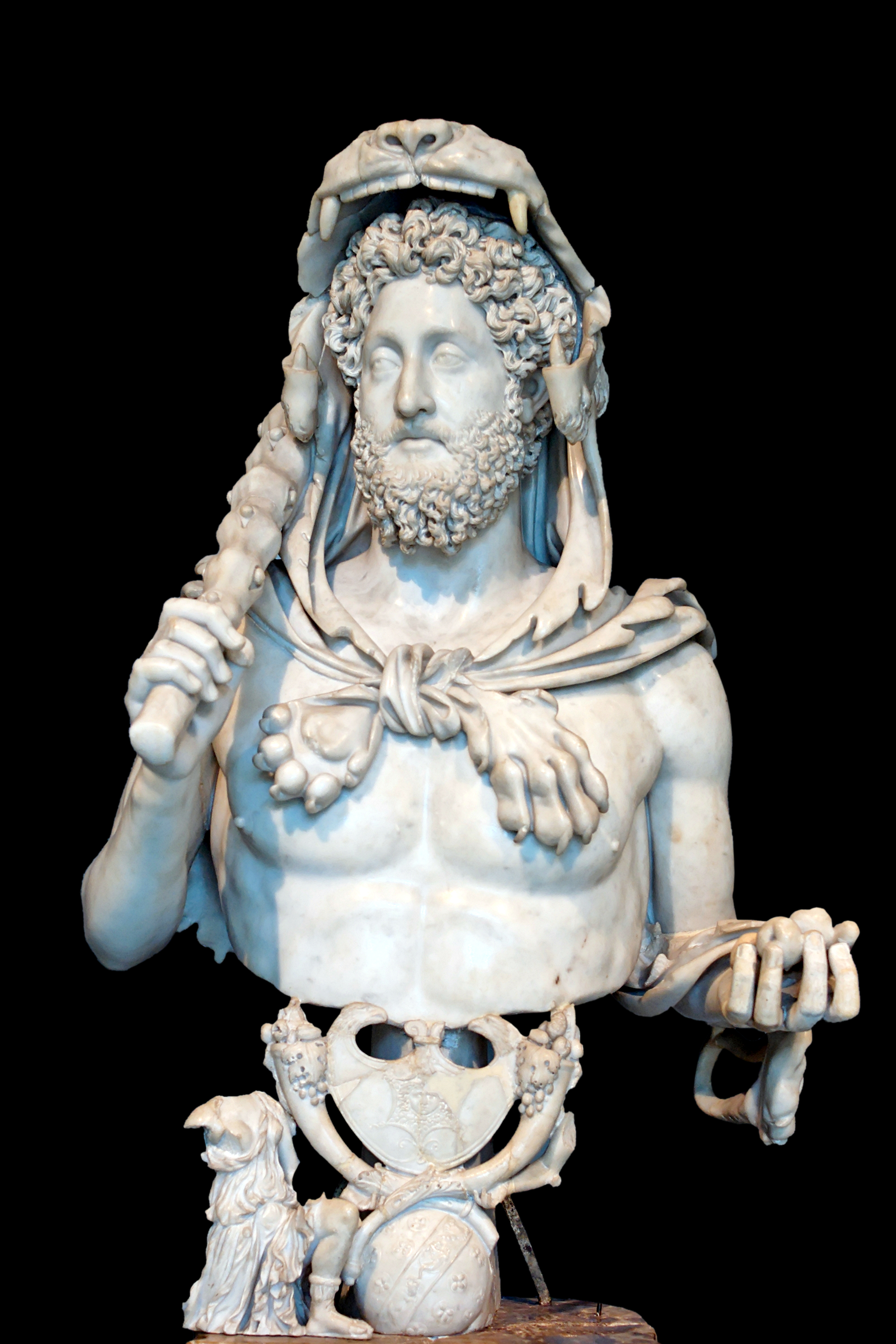
Bust of Commodus as Hercules
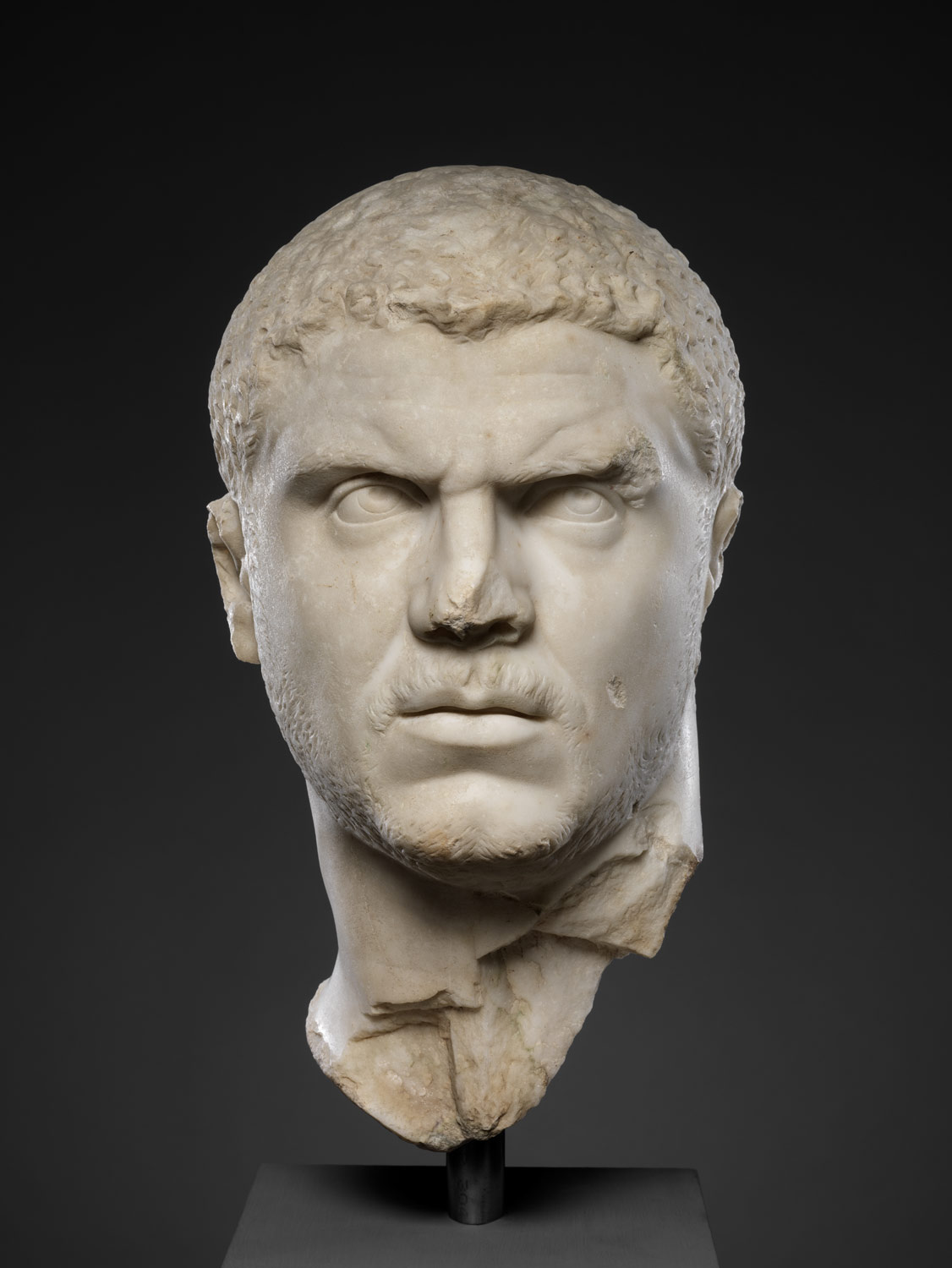
Bust of Caracalla

The Bust of Commodus as Hercules aims to show the viewer that this ruler is favored by the gods.  It aims to depict Commodus as a demi-god, one who is strong, handsome and heroic.  This sculptor was also interested in making Commodus look good.  He is shown as muscular, wrinkle-free, attractive and bearded.  He holds a club, which describes to us that he is capable and his lion hood shows the viewer that he can hunt and capture even the most ferocious beast.  The pedestal he resides upon has fig leaves and grapes which are often associated with the god Bacchus, or Dionysus, the god of wine and excess.  There is also a headless (probably had a head when she was carved) woman, perhaps a maenad, at the base of the bust.  This bust also exudes youth and virility.  This person is the epitome of youth, strength and heroism which is meant to sway the public's favor.  This statue was probably displayed publicly so that the ruler was often gazed upon and remind the citizens of his strength and power.

The Bust of Caracalla shows the wrinkles in his forehead, a furrowed brow indicating thoughtfulness or perhaps is meant to show how serious this man was.  This bust seems to explore verism, which is the interest in the faithful reproduction of the immediate visual and tactile appearance of subjects, or intense realism.  Caracalla, by being portrayed with 'flaws', is shown as being experienced and his realistic likeness allows persons (Patricians) to show that they are related to these famous persons.  

Wednesday, October 19, 2011

Week #5: Mystery Works of the Ancient Aegean

Unknown Art #1 (Possibly Minoan)
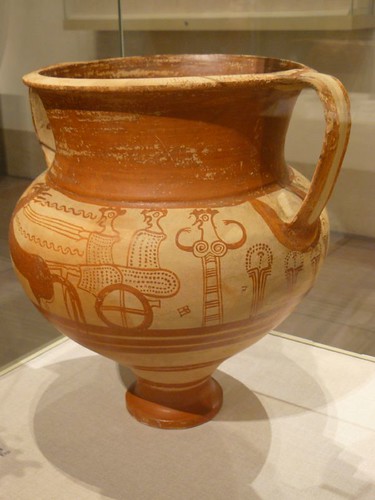
Unknown Art #2 (Possibly Mycenaean)
The first work, Unknown Art #1, is probably from the Minoan era, c. 2000 BCE to c. 1400 BCE.  This appears to be a wall painting, or fresco, of a young boy carrying fish. The shaved head, which is beginning to grow in and is painted slightly grey-blue indicates this person is entering adolescence.  This could be part of a larger wall painting which describes coming-of-age conventions of the time, to go along with any coming of age ceremonies the Minoans might have had.  The Minoans used bright colors in their frescoes, and you can see here that the colors used in the fishes and on the body of the young man are very saturated.  Like the Egyptians, the Minoans used drastic differences in skin color to differentiate between the two perceived sexes of their culture.  The "Stele of Amenemhat" shows this design consideration in Egyptian art on page 64 of Stokstad and Cothren's Art History.  The females have pale yellow skin, whereas the males have reddish brown skin.  Additionally, when comparing the Egyptian human form and the Minoan human form, you can see that the poses are very similar.  Shoulders are forward, the head is in profile and the hips are turned forward, with the head.  Even though the pose is very similar, not all Minoan works had this composite pose like the Egyptians.  The Egyptian style was also much more rigid than the Minoan style: this boy look much more fluid and even though it is very stylized, it seems to have more life than an Egyptian human form.

The second piece, a ceramic krater, probably from mainland Greece, or Mycenae.  The Mycenaean empire existed on the Greek mainland from c. 1600 BCE to c. 1100 BCE.  This piece of pottery is visibly well-made and the decorations on it are stylized, which points to a particular time in the Mycenaean: the final phase of the Helladic Bronze Age.  Like Ancient Egyptian and Near Eastern art, this krater has registers, delineating the scene from the rest of the pot.  In comparison to pots found on Crete, which are of the "marine style" (pg. 90, 4-10, Octopus Flask), being extremely busy and all parts are covered with marine life, the scenes depicted by the Mycenaeans are of people and life.  This particular pot seems to depict a woman standing with arms raised, facing a chariot that is moving away from her.  Also, the marine style was created by people who couldn't leave any negative space on the piece.  The Mycenaean piece shows a simple design that probably has a narrative.


Wednesday, October 12, 2011

Week #4: Ancient Egyptian Art

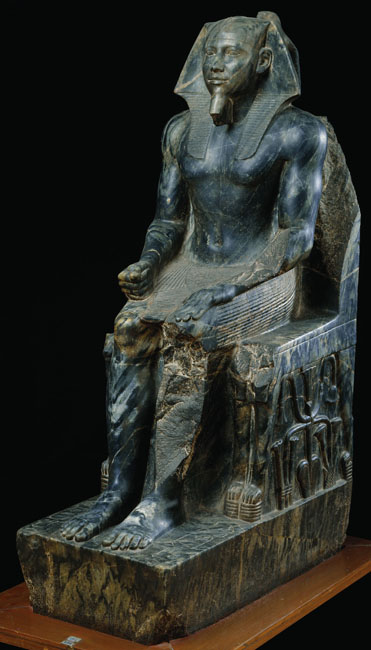
Khafre
Diorite-gabbro gneiss, H: 5' 6 1/8"
c. 2520-2494 BCE

The ancient Egyptians had a strict set of conventions with which to portray the human figure.  These conventions are not linked to lifelike representations of the world, but are rather linked to conceptual principles that are widely agreed upon between artists in ancient Egypt.  As a civilization which embraced mathematical systems, the ancient Egyptians developed a set of mathematical equations which determine proportion within design (p. 51, Stokstad & Cothren).  Artists of ancient Egypt use composite pose in order to show more detail regarding the human figure.  


In bas relief, they use a forward-facing eye, instead of a profile eye, registers are used throughout the work, helping to establish hierarchical proportions.  Sculptures made by ancient Egyptians evoke strength and permanence through their life-like three-dimensional representations out of extremely hard stone.  In regards to proportion, the larger the figure was, the more important they were:  the Palette of Narmer shows Narmer as the largest figure, with the smallest figures being defeated enemies and standard bearing servants.  

Wednesday, October 5, 2011

Week #3 - Ancient Near Eastern Art

Votive Figures
From the Square Temple, Eshnunna c. 2900-2600 BCE.
Limestone, alabaster, and gypsum; largest is 30".
Twelve fairly small statues are displayed together, showing a collection of Sumerian votive figures intended to be used as dedications to the gods.  These sculptures evoke veneration, peace and worship.  Each figure is unique and that gives a sense that they were probably carved by different artists.  The stylized features of these statues is conventional of Sumerian carvers and suggests these people had fairly strict standards for their offering statue carvers.

These sculptures are carved in the round and the artist(s) chose to have negative space between the elbows when carving the arms which are all in a praying gesture.  These statues weren't necessarily meant to be viewed by people, but meant to be offered to the gods as a way for the god(s) to bestow favor upon the person pictured.  When viewed out of context (i.e. in a Sumerian temple at an offering table), these statues, individually, would invoke the same sense of veneration, peace and prayer that they do together because of their calm facial arrangement and the arrangements of their hands and arms.

Wednesday, September 28, 2011

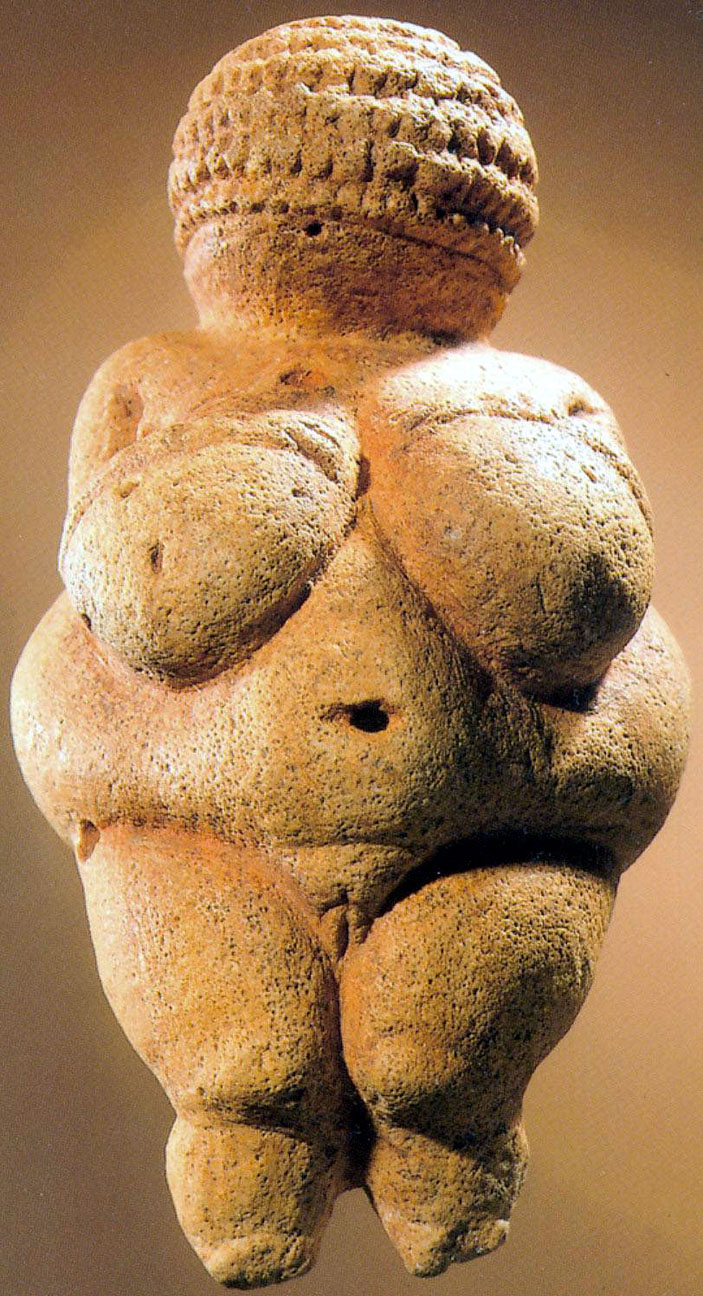
Week #2: Prehistoric Art: "Venus of Willendorf"


Venus of Willendorf
c. 24,000-22,000 BCE
Oolitic limestone
43/8 inches (11.1 cm) high
(Naturhistorisches Museum, Vienna)Venus of Willendorf)


Discovered in Austria by Josef Szombathy in about 1908, the statue was regarded "As the earliest known representation, she became the "first woman," acquiring a sort of Ur-Eve identity that focused suitably […] on the fascinating reality of the female body."

The name “Venus” was used in an ‘ironic and mocking’ way.  The “Venus of Willendorf” makes no attempts to hide her breasts or pubic area, which, at the time she was discovered would be considered immodest.  In being named “Venus” she is compared to Roman statues portraying a more lithe body structure, one which is seen as closer to “ideal” in modern society.  The statue is the opposite of the “tall, erotically curvaceous, nude young woman whose primary identity, as every heterosexual male recognizes, resides in her physical and sexual body.”  She is plump, perhaps short, her breasts are large and weighed down by their virility, perhaps suggesting that she has birthed many children and also nourished their bodies with her own. 
The term “Venus” is problematic in that it implies that this body is female.  That simply by having breasts and female genitalia, the statue shows femininity.  

Friday, September 23, 2011

Blog #1 - Introduction

Hello!

My name is Carolyn Buss, I am 24 and I am a studio art major.  I transferred to CWU in Winter 2011 from Edmonds Community College and hope to graduate Spring 2012.  *fingers crossed!*
I work primarily in 3D, with metal as my preferred medium.  I hope to someday teach jewelry and metalsmithing because I love sharing the specialized knowledge and skills that come with working in such a rigid, yet malleable medium.
My second love, and my hobby art, is photography.  People, jewelry, flowers and ironic arrangements of things are all subjects of my photography.
If I had any favorite artists, I would have to say Salvador Dali and Roy Lichtenstein.

I do not have any pets, I love to cook and I enjoy watching Doctor Who and Adventure Time.

Also:  I am a bit wary of the whole online class thing as I actually quite enjoy working and learning in a classroom.  I hope that this class will be the best online class I have taken so far.

~Carolyn