 |
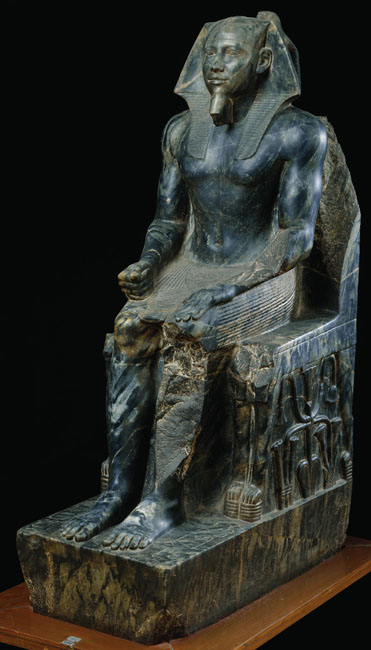
| Khafre Diorite-gabbro gneiss, H: 5' 6 1/8" c. 2520-2494 BCE |
The ancient Egyptians had a strict set of conventions with which to portray the human figure. These conventions are not linked to lifelike representations of the world, but are rather linked to conceptual principles that are widely agreed upon between artists in ancient Egypt. As a civilization which embraced mathematical systems, the ancient Egyptians developed a set of mathematical equations which determine proportion within design (p. 51, Stokstad & Cothren). Artists of ancient Egypt use composite pose in order to show more detail regarding the human figure.
In bas relief, they use a forward-facing eye, instead of a profile eye, registers are used throughout the work, helping to establish hierarchical proportions. Sculptures made by ancient Egyptians evoke strength and permanence through their life-like three-dimensional representations out of extremely hard stone. In regards to proportion, the larger the figure was, the more important they were: the Palette of Narmer shows Narmer as the largest figure, with the smallest figures being defeated enemies and standard bearing servants.
The statue "Khafre" is carved from gneiss, a hard igneous rock. This sculpture evokes strength, firm rule and is a representation of the young Khafre. The muscular build of the statue, and the first resting on the knee invite the viewer to see this as a representation of a ruler. We know that this statue is a "ka" statue, a resting place for the soul of the deceased. Khafre wears the traditional royal costume and sits in a throne, while his head is embraced by the falcon, symbolizing that the god Horus protects him. The way Khafre is portrayed, as a young, virile kingly man, is conventional way that ancient Egyptian sculptors would have portrayed their king at the time.
In contrast with the "Khafre" statue, the statue of Akhenaten - "Colossal Figure of Akhenaten" - portrays a very androgynous figure, one with swelling hips and thighs, a slightly sagging belly, protruding clavical bones, full and animated lips, dimples and a long neck are all wrapped in the king's traditional costume. The reign of Akhenaten brought new creativity and physical distortions to portraits and representations of the king.
This new style of artistic representation brings up the subject of creativity in art. If artists stick to the conventions of the time, then there won't be much difference between one artists' work and another. The rise of a new style shows that artists in ancient Egypt were tired of the strict, stoic look of the older art. They wanted their statues and reliefs to show life how it was lived, not as it should be. The relief "Akhenaten and His Family" shows the frenetic energy of his three babies and their love for their family.
Creativity was probably not the first thing on the minds of the carvers who made ancient Egyptian stone sculpture and reliefs. They were likely commissioned artists who had to make the items to specific instruction by the commissioner. That they were commissioned and told what to carve does not necessarily mean the artists weren't creative. They may have had visions for how to put a particular scene together, or new ideas on how to arrange symbols pertinent to the composition.
Assuming that the people carvings the palettes, steles, statues and sculptures are craftspeople and not artists, then I would say that ancient Egyptian art is not particularly creative, until the reign of Ankhenaten at least. The craftspeople probably learned everything they knew from a line of other stone crafters and sculptors and were told what to do. There is little creativity in this endeavor; I know this to be true because I have lived that type of life, as a production jewelry maker.
Whether or not the artists who created ancient Egyptian work were creative or not does not make any difference: this work is art, it doesn't have to be particularly creative to be of value because the work shows how art evolves as human culture evolves through history.


I really liked the way that you discussed the changes of Egyptian art concerning the depiction of the pharaohs. From picture perfect to real and just like everyone else with major or minor flaw being allowed display. To quote you, "They wanted their statues and reliefs to show life how it was lived, not as it should be." It is this change in artistic vision and the acceptance of it within the royal courts that begins to change our perceptions of what is real and what is not. Thank you for reminding us of this major change from mathematical perfection.
ReplyDeleteYou make a good point. Based on your assumption, I also agree that these craftspeople are not as creative. If there is one thing I have also learned from experience is that creative people have to be allowed to be creative. I understand that everything has to have structure but within that structure there has to be freedom for artistic people to be creative. Mcdonaldization should not be a part of an artist life!
ReplyDeleteI somewhat disagree with what you said about the Egyptian art and how it was not very creative until the reign of Ankgenaten. I think, although the sculptures all looked similar and not very humanly in design, there is still a lot of creativity in each one. There is at least a couple details that stand out in each piece of artwork that are not seen in the other works, and this makes each piece be creative and unique on its own. But I really liked how you backed up your beliefs about ancient Egyptian art with personal experience. Great job!
ReplyDeleteI think the mathematical formula in their artwork/reliefs/paintings added appeal! Since it was such a repeated convention, its significance to their society/culture makes it much more interesting to look at; how stylized it is. Statues as resting places for the deceased are also very intriguing! So, if that statue happened to be damaged a significant amount, their soul would be disturbed as well, right? Interesting to think about.
ReplyDeleteI like that you viewed creativity during Akhenaten's reign. The different stylized royal art is fun to look at, I certainly enjoy seeing how jolly-like and the loving expression is seen in "Akhenaten and His Family" instead of the continually stoic expressions normally seen, but I think it is also interesting when the next reign reverted to conventional royal art and still kept some elements of the new style in it.
I find it very interesting that the Egyptians assigned mathematical equations to what was appealing and beautiful. I remember watching a program a while ago that talked about the same thing, that beauty can be broken down into equations. For example, both Marilyn Monroe and Halle Barry share the same proportions in their faces that make them very beautiful people.
ReplyDeleteI wonder if the Egyptians did this so that an artist depicting the king wouldn't put their own feelings about that ruler into the piece by making them disfigured or distorted. Sometimes I have a hard time telling any of the apart!