 |
| Unknown Art #1 (Possibly Minoan) |
 |
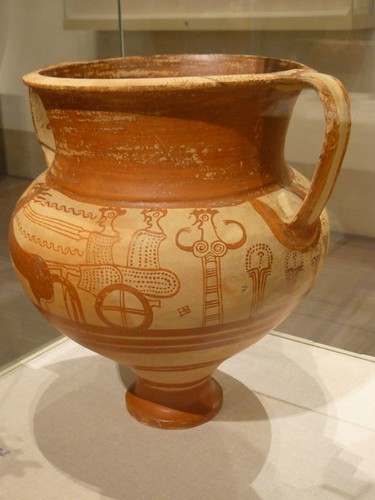
| Unknown Art #2 (Possibly Mycenaean) |
The first work, Unknown Art #1, is probably from the Minoan era, c. 2000
BCE to c. 1400
BCE. This appears to be a wall painting, or
fresco, of a young boy carrying fish. The shaved head, which is beginning to grow in and is painted slightly grey-blue indicates this person is entering adolescence. This could be part of a larger wall painting which describes coming-of-age conventions of the time, to go along with any coming of age ceremonies the Minoans might have had. The Minoans used bright colors in their frescoes, and you can see here that the colors used in the fishes and on the body of the young man are very saturated. Like the Egyptians, the Minoans used drastic differences in skin color to differentiate between the two perceived sexes of their culture. The "Stele of Amenemhat" shows this design consideration in Egyptian art on page 64 of Stokstad and Cothren's
Art History. The females have pale yellow skin, whereas the males have reddish brown skin. Additionally, when comparing the Egyptian human form and the Minoan human form, you can see that the poses are very similar. Shoulders are forward, the head is in profile and the hips are turned forward, with the head. Even though the pose is very similar, not all Minoan works had this composite pose like the Egyptians. The Egyptian style was also much more rigid than the Minoan style: this boy look much more fluid and even though it is very stylized, it seems to have more life than an Egyptian human form.
The second piece, a ceramic krater, probably from mainland Greece, or Mycenae. The Mycenaean empire existed on the Greek mainland from c. 1600
BCE to c. 1100
BCE. This piece of pottery is visibly well-made and the decorations on it are stylized, which points to a particular time in the Mycenaean: the final phase of the Helladic Bronze Age. Like Ancient Egyptian and Near Eastern art, this krater has registers, delineating the scene from the rest of the pot. In comparison to pots found on Crete, which are of the "marine style" (pg. 90, 4-10, Octopus Flask), being extremely busy and all parts are covered with marine life, the scenes depicted by the Mycenaeans are of people and life. This particular pot seems to depict a woman standing with arms raised, facing a chariot that is moving away from her. Also, the marine style was created by people who couldn't leave any negative space on the piece. The Mycenaean piece shows a simple design that probably has a narrative.



Good thoughts. Your attributions are spot-on!
ReplyDeleteYou are right that the Mycenaeans depicted scenes with people and life - more specifically, they painted their vases with people. Minoans didn't paint their human figures or "scenes from life" (see the Harvester Vase on p. 89). Instead, Minoans carved such figures and scenes. If Minoans did paint on their vases, it would be to depict marine life (like the octopus vase) and other abstract designs (like the Kamares ware jug).
-Prof. Bowen
I forgot about the blue shaved head relating to an entrance of adolescence, I'm glad I was reminded by your post! You supported your claims very well, in fact, I think better than I did since I chose the blog option too. The krater could depict a military scene and mourning, like in "Warrior Krater" where the woman throws her arm(s) up in the air as a gesture of grievance while the warriors leave to war. I think the Mycenaeans were interesting, actually, I like looking at art from militaristic cultures. Haha.
ReplyDeleteI never knew the Egyptian and Minoan artists used different color of skin to distinguish between the two sexes. I wonder what these colors represent and why the boys' skins were reddish and the girls' were yellowish? Hmm, im going to have to look it up:) Great post!
ReplyDeleteI too thought of the "Warrior Krater" when I saw the vase. The stylization of the human figures through the use of simple lines to suggest the body. Also the painting style of painting in areas with one solid color seems similar. It's interesting how much the potter's wheel allowed new creativity in vessel shapes and made the Minoan and the Mycenaean pots and jars so valuable to other cultures as well.
ReplyDeleteI think the idea of story telling through painted pottery is pretty interesting and probably a much harder task to accomplish (successfully) than one thinks. I think one of the things that makes ancient pottery so beautiful is the amount of decoration involved; it's rare nowadays to see pottery or ceramics decorated with story like compositions. I feel like that was a thing of the past, and something that was very culturally oriented. I would like to see artwork similar in today's societies and cultures, I bet they would be wild!
ReplyDeleteYou did a good job comparing the works of art. What I found most interesting about the Mycenaean piece you talked about are the registers. It is such a great way to keep art clean and simple while telling a story. I think putting their history and culture on items such as the krater is a smart way of spreading their culture and making a presence within their society. It would be neat to see something like that nowadays and not random illustrations from a random worker. For example, plates that have flowers on them with no real purpose besides it looks nice. Sometimes I wonder why we don't take pride in our history enough to put it down everywhere we can like the people from the Mycenaean period.
ReplyDelete