 |
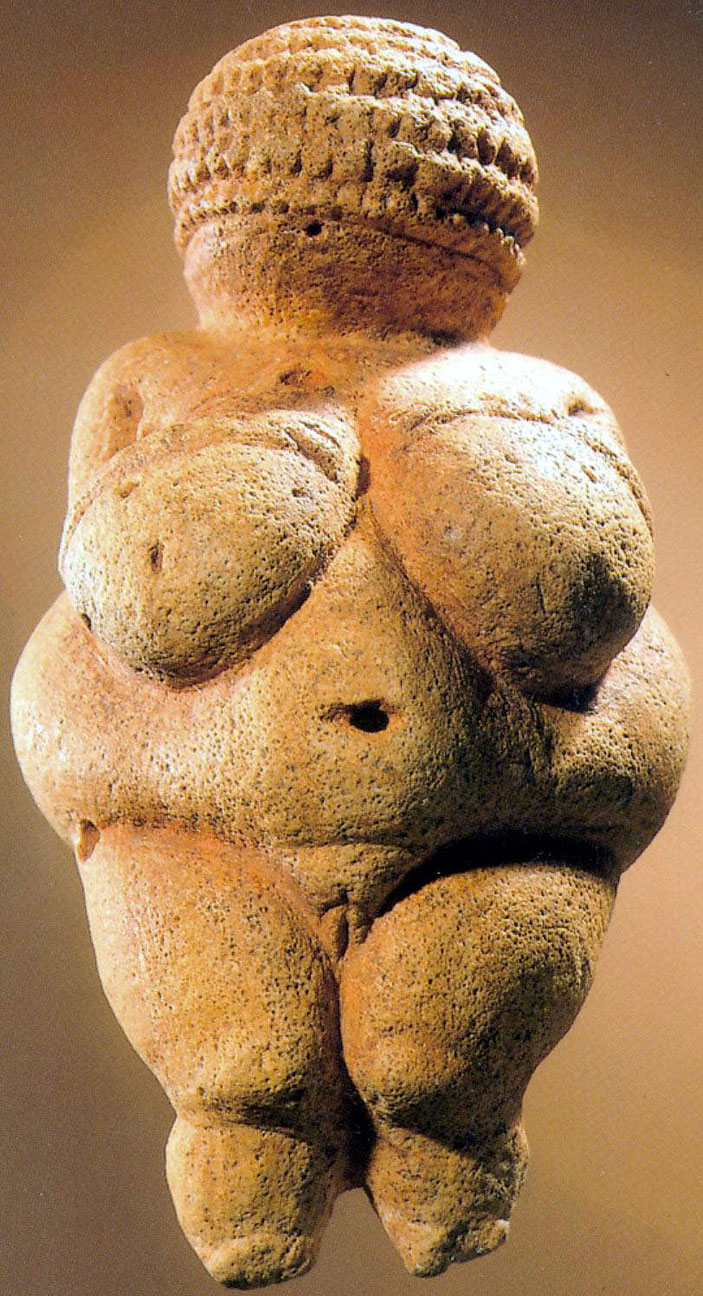
Venus of Willendorf
c. 24,000-22,000 BCE
Oolitic limestone
43/8 inches (11.1 cm) high
( |
Discovered in Austria
The name “Venus” was used in
an ‘ironic and mocking’ way. The “Venus
of Willendorf” makes no attempts to hide her breasts or pubic area, which, at
the time she was discovered would be considered immodest. In being named “Venus” she is compared to
Roman statues portraying a more lithe body structure, one which is seen as closer
to “ideal” in modern society. The statue is the opposite of the “tall, erotically curvaceous, nude young
woman whose primary identity, as every heterosexual male recognizes, resides in
her physical and sexual body.” She is
plump, perhaps short, her breasts are large and weighed down by their virility,
perhaps suggesting that she has birthed many children and also nourished their
bodies with her own.
The term “Venus” is
problematic in that it implies that this body is female. That simply by having breasts and female
genitalia, the statue shows femininity.
As Witcombe states at the end of the second section, this statue is
“visibly biologically feminine, but she is not feminine; the name “Venus”
imposes up[on] her a gendered femininity that she does not have.” A Western, patriarchical point of view tells
us that simply by being biologically female, obviously that person is feminine;
however, society and culture define femininity, not genitalia. It is unfair to the statue and the maker to
imply that there is any femininity in this statue because to our Western eyes,
of course it does, but to a different culture it may be seen differently.
In regard to how the figure
is supposed to be displayed or used, Witcombe describes it as being something
meant to be held in the hand: “As fingers are imagined gripping her rounded
adipose masses, she becomes a remarkably sensuous object, her flesh seemingly
soft and yielding to the touch.” The
ideal beauty in American culture is not fat, she does not have large, heavy
breasts or a belly of size. The ideal
beauty in the United States
It is interesting to note
that unless there was a model for the sculptor to look at while completing this
figurine, the artists might not have been able to even make one that looks at
least somewhat accurate. I also wonder
who carved the statue. Was it a medicine
man or medicine woman trying to help a woman conceive a child? Is the statue meant as a visual aid for the
Earth Goddess? If it is a statue of the
Goddess, was it then carved by a Priestess or simply someone who wanted to be
closer to their deity? There is really
no indication that the statue is divine in nature, though, which is why some
scholars have chosen to use the word “Woman” instead of “Venus.” Scholars want to demystify this statue and
allow people to think of her in broader terms.
Part of me wonders if those
people are haters of the fat body. As a
fat woman, I actually identify, at least a little, with this statue. It more closely resembles my body than most
of my peers’ bodies and I think for me it is easier to believe that this statue
is of the ideal prehistoric woman, or at least a “famous” prehistoric
woman. I think of it in those terms
because I am also aware of fan art. I
cannot imagine a world without fan art and perhaps this statue, and others like
it across the European and Asian continents were fan art. That idea could also extend to the Goddess
idea.
Finally, why do we speak of
a statue which we really know nothing about?
Why is this statue important to the art world? Mostly we speak of it because it is a
significant find in terms of anthropological studies, but why do we look at it
as art? Is it art? Or it is a token, or
a tool? Perhaps then we must wonder what
we think of as art. Did the maker of
this statue think of it as art? Did the
painters of the caves in France
As a maker myself, I think
of my work as art. I think that perhaps
the person who carved this figurine made it for a purpose, but also as
art. It may have been carved far from where
it was found and was bartered for and somehow found its way to what would one
day be named Willendorf , Austria
______
Witcombe, Christopher L.C. E. Venus of Willendorf. Art History Resources. 2005. http://arthistoryresources.net/willendorf/


Great thoughts, Carolyn. I like that this topic got you to think about some other questions and issues. I also wonder who carved this statue. My favorite theory (which I presented in lecture and is briefly mentioned on p. 7 of our textbook) is that this figurine was created by a woman. An scholar named McDermott suggested that these figurines were created by pregnant women who were using their own bodies as models (and the exaggerations in anatomy resulted from the distorted, foreshortened view that appears when someone is down at their body). It's a really compelling argument, I think.
ReplyDelete-Prof. Bowen
I could certainly see how a woman might carve a statuette using herself as a model in order to give it to another woman as a fertility token. That would also account for the unnaturally thin arms and the swollen breasts and belly.
ReplyDeleteIn regard to the face, assuming the artist was crafting it for the above purpose, didn't want to attribute fertility to a specific person, but that the token could be used for many different women and hopefully bring about the same outcome.
Hi, Carolyn
ReplyDeleteWow, your post is very well written. I enjoyed reading your thoughts and comments. I find it interesting as well that the figurine seems to be meant to be held in the hand. To me this implies that it was something to be kept close, to be held, since it's not free standing. Since there doesn't seem to be evidence of much overall damage to the piece, considering how old the piece is, one would think that the owners of the figurine were careful of it and took good care of it. This seems to imply that the people associated with the piece found that this was a piece of worth, whether it was used as a fertility charm or a token, or to be simply admired .
I'll be following your posts.
Sarah
Following the thread of your last comment, assuming that the figure was carved by a pregnant woman, do you think the figure was meant to be given to a daughter? Items are often passed through family lines, and maybe this figure was meant to assure that the daughter would be fertile as well. It could be an item that was passed from mother to daughter, and not necessarily an item meant for men at all.
ReplyDeleteSarah
Wow, this is a very well written response. I like that you not only assessed the work itself, but related to yourself, and other work that is made today. I like that you addressed the issue of society's ideal image of females, even though it may have been slightly different then what it was when the statue was made. I do think we need to remember that this statue isn't a "fat woman" but a "pregnant woman."
ReplyDeleteSarah, I think perhaps it could have been made for a daughter, as a keepsake and family heirloom-type object.
ReplyDeleteLiz, We can't know for sure whether it symbolizes or represents a pregnant woman. I do not think of "fat" as a negative descriptive word, but simply a descriptive word, so I'm not speaking negatively about the statue when I say the word fat. Also, everything we think we know about this statue is all supposition, informed speculation and analysis. Each person will have their own view on the statue. :]
Thank you for the lovely, thoughtful post! This piece, and the others like it always incites fascinating discussion!
ReplyDeleteI always find it hard to pick one particular reading of what it is - instead I like to explore all the possibilities forwarded by scholars from different directions. Prof. Witcombe's is indeed what we would view as a standard art historical viewpoint - but there is a bit more to this perhaps. Prehistoric art often is closely linked with anthropology, and the study of human development.
I would invite you to view this video clip that is relevant to your topic, I presented it in the context of a discussion about the evolution of the representation of the human form. It is an excerpt from Dr. Nigel Spivey's How Art made the World discussing Prof. Ramachandran's work on the Venus of Willendorf and simialar figures, which approached the topic from a neurocognitive persepective.
clip link:
http://youtu.be/_voC2S2iIfg
original post - discussing Professor Ramachandran's work on that 'Venus' (et al).
Pride, Prejudice & Neurocognition
Keep up the great work!
Kind Regards
H Niyazi
Three Pipe Problem
http://3pipe.net