 |
| Sketch for "Oath on the Rütli," Female Figure (verso), 1779/81; 1785/90 (verso)Oil on canvas stretcher: 29 15/16 x 26 9/16 in. (76 x 67.5 cm); irregular edges of the original canvas: 28 5/8 x 22 3/4 in. (72.7 x 57.8 cm); edges of the Oath on the Rütli image: 25 5/8 x 21 3/8 in. (65.1 x 54.3 cm) Anonymous gift, 1980.170 |

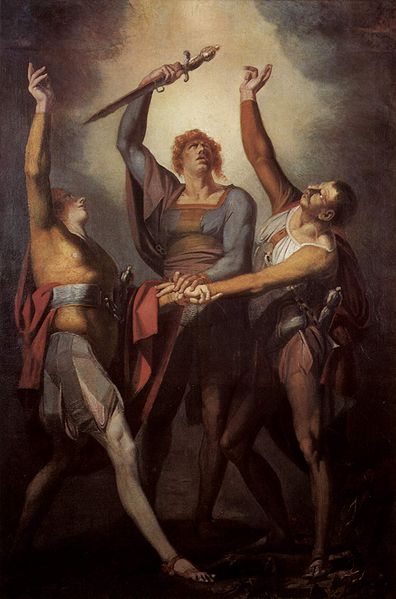 |
| Henry Fuseli, Oath on the Rutli, 1780, oil on canvas |
Although Fuseli worked in ethereal and particularly dark subject matter, he also worked as a history painter. The painting "Oath on the Rutli" (see right), although not a historically corroborated event, is widely celebrated by the Swiss (Fuseli is of Swiss descent) as the day when the Old Swiss Confederacy came into being. Fuseli celebrates this not-implausible fictional event in a dark scene, with the sun breaking out of an opening in the clouds, three men holding their right hands up to the sky, one holding a sword, presumably the Rutli, with left hands clasps together in a binding oath. The sketch of the Oath painting is considered to be one of the closest to the finished piece, looking more like it than the other studies that have been found and exhibited. This was the only painting Fuseli ever signed and dated, pointing to his unique Swiss heritage and the particular pride he takes in that fact. Although he is considered a British painter, he was born in Zurich.
The above paintings are a double sided sketch; the side with the three men is for the painting to the right, called Oath of Rutli. You can see how Fuseli changed the colors and worked through composition with the sketch and in comparison with the final, the sketch is much brighter and evokes more movement through the hurried brushstrokes used. The painting on the back of the sketch is called "Psyche" who is the Greek goddess of the soul. Fuseli depicts Psyche as a beautiful , but possible fearful windswept woman. The palette used is subdued, suggesting an other-worldly and ethereal setting. Flowers in her hair, and exposed breasts illustrate her goodness and her vulnerability, respectively. Her stance and the look on her face bear the mark of a woman conflicted: her face pointed one way, but her body is positioned to go the opposite.
Fuseli had a varied and interesting career, one more thing to note was that he has much work in secret. He sketched and worked on erotic works, drawings mostly, of which most were purportedly burned after his death by his wife. What a shame, for it would have been lovely to see the way he depicted the baudy acts of the 18th century people in his particularly Romantic stylings.
Bibliography:
1. Paintings and Drawings by Fuseli
The Burlington Magazine , Vol. 92, No. 565 (Apr., 1950), pp. 111-113
Published by: The Burlington Magazine Publications Ltd.
Article Stable URL: http://www.jstor.org/stable/870276
2. Public Virtue and Private Terror: A Two-Sided Oil Sketch by Henry Fuseli
Zeitschrift für Kunstgeschichte , 53. Bd., H. 1 (1990), pp. 89-106
Published by: Deutscher Kunstverlag GmbH Munchen Berlin
Article Stable URL: http://www.jstor.org/stable/1482506
3. "Between Fantasy And Angst: Assessing The Subject And Meaning Of Henry Fuseli's Late Pornographic Drawings, 1800-25."
Smith, Camilla. Art History 33.3 (2010): 420-447. Art Full Text (H.W. Wilson). Web. 29 Feb. 2012.
Smith, Camilla. Art History 33.3 (2010): 420-447. Art Full Text (H.W. Wilson). Web. 29 Feb. 2012.
4. Henry Fuseli. British, 1741-1825. Sketch for "Oath on the Rütli," Female Figure (verso), 1779/81; 1785/90 (verso). Oil on canvas http://www.artic.edu/aic/collections/artwork/59989?search_id=1


Nice post! It's interesting to see how this painting was created just a few years before David's "Oath of the Horatii" (1784-1785). We'll be reading about David's painting next week (it's on p. 934 of our textbook). I'm not aware of any direct connection historical connection between David and Fuseli's painting, but there definitely are similar compositions with outstretched arms and sword(s). I also know that one writer compared these two paintings, saying that they both "focus explicitly on the traditional masculine attributes of energy, force, and duty" (The Enlightened Eye, p. 137).
ReplyDelete-Prof. Bowen
The sketch reminds me of the Baroque period with it's bright contrasting colors and the drama of the moment, along with the strong diagonals formed by the legs. There is a Humanist interest in anatomy with the muscles that are really defined and highlighted by the light and dark brushstrokes. I love seeing the finished painting in contrast to the sketch. Obviously, the painting has much more refined brushstrokes and lines but their compositions and contrasting light and dark elements remain the same. Thanks for the interesting post about Fuseli.
ReplyDeleteI did the same artist and one thing that I enjoyed and what I see as a trend with this artist is the apocalyptic nature of most of his images. While he does dark paintings, you mentioned his historic paintings as well. But the even with that his historic images have some dark, apocalyptic theme to it. Just an interesting theme.
ReplyDeleteI have to agree with Sarah, this piece definitely has baroque-esk features. especially with the pose of the figures and the emotion in the piece.
ReplyDelete